Meeting of the Waters & Exotic Animal Extravaganza= An Amazing Last Day

bridges, palm trees, cool trees, lillies, sloths, baby crocodiles, flavelas, and don't forget.. SNAKE!

bridges, palm trees, cool trees, lillies, sloths, baby crocodiles, flavelas, and don’t forget.. SNAKE!

100_5250 100_5280 100_5281 100_5299 100_5301 100_5305 100_5326 100_5329 100_5340 100_5352 100_5353 100_5370 100_5373

100_5374

I feel like I could spend a lot of time telling you all about my last day in Brazil, but I’m going to let my pictures do most of the talking. Pictures do speak louder than words, right. I will say a few things though.  The whole trip- the ENTIRE trip- I was looking forward to this day. For this was the day that I was going to finally see the mighty Amazon in all of its glory. Let me tell you, it did not disappoint.  Seeing the meeting of the waters took my breath away. We totally lucked out because it was a beautiful day.  We spent our whole day on the water- we were able to see sloths, snakes, crocodiles, and we even swam with pink dolphins. All in all, it was a day that made me want to come back to Manaus- even with all of the heartbreak of poverty because it is a beautiful place full of biodiversity and bursting with life.


Bus Fires, Traditional Blessings, Hiking & Hammocks = An Amazon Rainforest Experience of a Lifetime

100_5238 100_5230 100_5216

It's quite fitting that I wore my CCE= "Change your world. Change yourself" shirt!

It’s quite fitting that I wore my CCE= “Change your world. Change yourself” shirt!


On Thursday, May 23rd we started our adventure into the Amazon Rainforest bright and early. We were off for an adventure from the get-go because our bus literally caught in fire just as we were pulling up to the port to head to our first destination. It was frightening experiencing this at the time.  Many students, and to my dismay- GUIDE- downplayed the whole issue, trying to make it seem like it was not that big of a deal. I am thankful that everyone was able to get off the bus and away before anything could happen.

We then got split up onto two incredibly small boats and road on the Rio Negro for about an hour, where we got off at a really small village.  We were fed a traditional breakfast, and then taken on a small hike where we were brought into a traditional hut made of banana leaves and logs. We were greeted by the leader who welcomed us, and started the ceremony that blessed us on our journey in the Amazon. I was astounded by the men, women, children and babies in their traditional indigenous dress using instruments that they made themselves- singing in song and dance for the purpose of making us feel like a part of their family and community. This is one of the moments on the trip that I will remember for the rest of my life. This pure genuineness impressed my heart, and makes me want to be even more welcoming and understanding of others that come into my community.

After the ceremony we were brought back up to the village where we were given a feast of wonderful fish, chicken and rice. We then got back into the boats and were taken to our next stop where we started our 3 hour hike in the forest to reach the two different families that we would be staying at overnight. I ended up staying with the faculty and two other students with a mom, her daughter and grandma in her house.  We were welcomed with open arms and given so much food and countless smiles. Even through our many attempts at broken translation, I knew that they family was happy we were able to join them, and I was happy to be staying at this completely awesome, functional home in the middle of the Amazon.

That night I slept in a hammock outside on the porch with two other students and 1 faculty member.  When I woke up in the morning I was relieved to have survived the night in the middle of the Amazon, and happy to be hiking out of the forest on our way back into Manaus.

I have to say that this had to have been one of the most impactful experiences from the whole trip.  I think in my mind I had this grandiose image of what the Amazon would be, and in all honesty- it was rainforest. Granted, there were amazing animals and plants there, but it was not anywhere as lush and overgrown as I thought it would be.  As I was riding back on the boat I kept thinking about how even in the middle of a remote, yet mildly accessible rainforest, there are entire families that live their day to day life and are completely content and happy with their way of life.  There are communities that now how to survive, and are able to just like I am in Pullman, WA.

I almost feel like now I am more apt to continue my interest in water justice and building awareness around these issues because I have been there. I have been there, and I know in the bottom of my heart that people 3,000 miles away from me are living their lives like they know how, and should be. Their livelihoods and wellbeing depend upon the land just like mine does in a different way.  I am so happy that I was able to meet that family on a more personal level, and leave the rainforest with my assumptions completely shattered. I am aware now, and I want to help others grow in their awareness as well.


Trash + Poverty = A Very Polluted Rio Negro

ImageImage

We got into Manaus at about 1 am on Tuesday, May 21st. I was instantly struck by the humidity and how much hotter AND grosser I felt in comparison to Sao Paulo and Piracicaba.  The hotel we were staying at struck me as a prison, and I was instantly in a bad mood.  The last week and a half had finally caught up with me.. and I wanted to get back to the US PRONTO.  After taking a shower, which was conveniently housed next to the toilet (no shower curtain), I hastily fell asleep hoping that I wasn’t eaten alive by bed bugs.

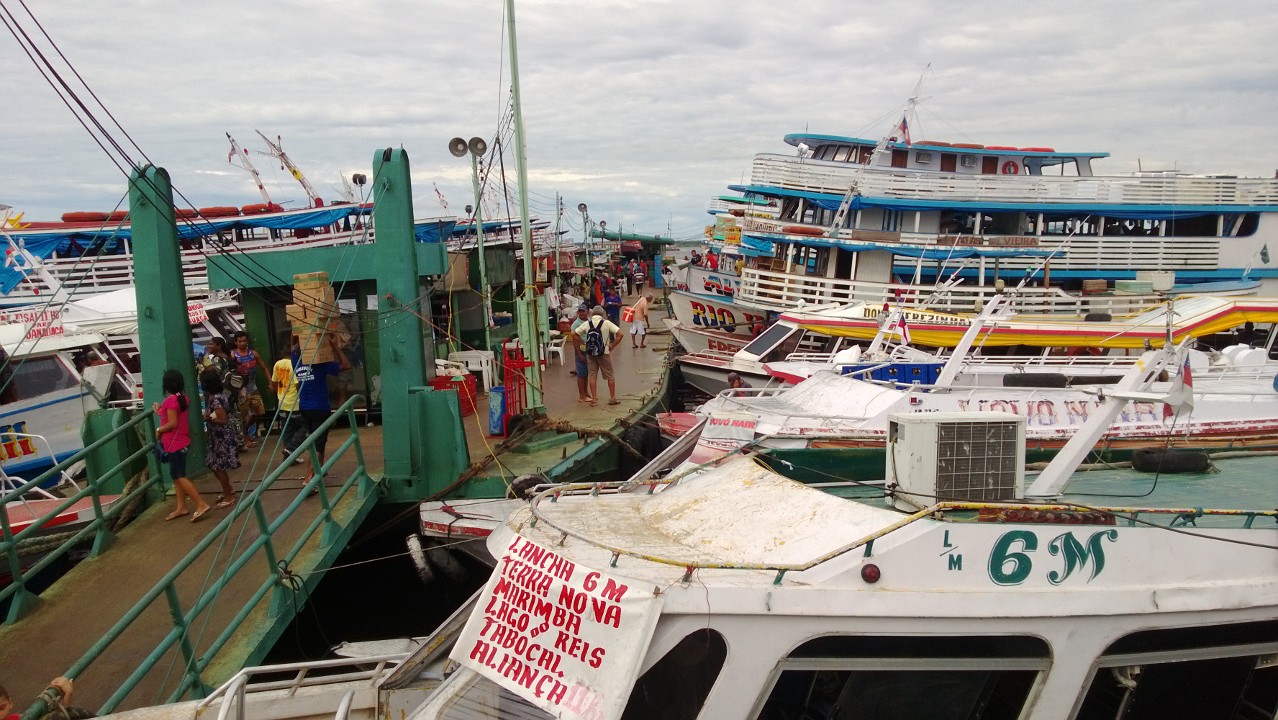
I did feel better in the morning, when we started our adventure a few blocks away to the Market, which is housed along the Rio Negro. The Rio Negro is one of the largest tributaries of the Amazon River, and is black- where it gets its name from. The water itself actually looks like Coca-Cola.

My heart cried and I was so shocked by seeing the poverty that I was walking through.  In my heart of hearts I always knew that people lived in poverished situations, but for the first time in my life I was seeing the real deal. This was not 1 or 2 homeless people in Seattle, WA, but an entire community in poverty. There was so much trash in the river and roads- the physical state that the community was in was falling apart and to put it simply-sad.  I started getting angry, thinking about how people could live in situations such as this, and my senses finally kicked in. This is what they know- this is what their lives are.  Is it fair and appropriate to feel so sad and effected by this place?

I still am struck by the sheer volume of trash that floats in the river- that all these people depend on for their transportation and sustenance needs.  Our guide told us, “well you can’t really throw anything away”. This impacted me- heavily. No, you can’t really throw anything away. Where is “away?!”  Everyday in the US you throw things away- you take your trash out.. but where does the trash actually go? So, yes- there is trash in the river, but where else is it supposed to go?

All You Want to Know.. On Sugar Bioethanol!

On Monday, May 20th– we spent the majority of our morning at SURCAL- a sugar bioethanol producer. I learned a lot while there, so I am going to take some time to inform you on all that I learned through the Directors that took the time to speak with us. J

Brazil is the largest producer of sugar in the world as well as the largest producer of sugar bioethanol.  At one point in the recent past, 85% of cars produced in the world ran solely on bioethanol, now less than 1% of cars produced run solely on ethanol. Sugar and ethanol come from the same crop. A flex motor can run on ethanol or gasoline. This was developed in the 90’s. Now 85% of all cars produced have this motor. When ethanol is 70 % lower than the price of gas, that it’s one it becomes advantageous to produce ethanol. The production of ethanol is also more advantageous than the production of gasoline.

Sugarcane was introduced to Brazil in the 1500’s. Brazil has been working with sugar cane for more than 500 years. Cuba used to produce more sugarcane, but not anymore. 550 million tons of sugarcane are produced a year. Roughly a 50/50 split between ethanol and sugar. This increase is due to more land, new technology and new cultivars. Burning of land in sugarcane harvesting is now prohibited.  1 acre burned of sugar cane is the equivalent of 30 barrels of petroleum going into the atmosphere.

Now there is new areas of Brazil that are being used to grow crops for sugar. This is to Brazil as the west is to the United States. The sugarcane is renewed on cycles. In a field there are typically 6-7 crops. They are on rotation. Planting of the sugarcane is the biggest production cost.

Cycle: sugarcane= sugar = energy

Sugarcane= ethanol = energy

Energy produced amounts to about 5-6% of Brazil’s total energy production in a year. In the future, they would like 10-11% of total energy production to come from sugarcane. There is now research being done on the economic gain from producing more alcohol from the byproduct or producing energy with the byproduct. This doesn’t take into account the energy demand of Brazil’s residents.

One take away: decisions are always being made based on the economic benefit; what action is the most cost effective.

Production plants: must be flat; logistics= close to rivers and highways; the plants must be able to produce 1.5 million tons or more a year.

Importance of sugarcane to the development of Brazil:

Way back when it created a lot of employment- 1000 people on a farm x 400 farms= a lot of people.

Biggest problems is not production, but the technology of transporting goods in a timely manner as well as logistics. In example, the US has given much attention to water transportation like canals and dams. This makes it very cheap. Rail has been hurt very bad… it was privatized and now rail is trying to make up for lost time. Water transport is cheapest and then rail is after that. Does Brazil need to be following in the footsteps of the US regarding the dam infrastructure for subsidized agricultural crops? I say: NO.

A few take aways from SURCAL:  I am completely floored and amazed that there are sustainable companies such as this that are continually looking to make better processes and try to reduce waste. I would not be surprised if within the next few years SURCAL becomes completely green in that they don’t need to rely on any outside sources for their production, and also have zero waste.  Before going to Brazil I was operating on this assumption that Brazil is one of the most sustainable countries in the planet—I still agree with this assumption, although they are doing other things- like wanting to invest in dam infrastructure that changes my mind.

History through Cemeteries

Sunday, May 19th was a “choose your adventure” type of day.   A few people decided to stay behind at the hotel and do some local shopping in Piracicaba. I decided to go with the majority to find an American cemetery that was nearby.  We ended up getting lost and turning around at least 3 times because they had changed the roads and the maps we had did not reflect that. We lucked out when we got there because the family that lived on the land and tended to the plots were there to let us inside.  I was immediately overtaken by the obelisk that stood alone in the center of a field of grass- to me, it looked like a miniaturized Washington Memorial.  I was thankful to be able to walk around the cemetery in my own solitude to read many of the gravestones. Some of the Americans had been there for close to 150 years.

I was most struck by the graves of many babies and children. Being an Auntie to two wonderful kiddos- and knowing how much they mean to me made this even harder for me to see. I could not imagine what it would be like to flee America because you want to continue your Southern way of life- only to be struck by the sudden tragedy of having your baby taken away from you.  I guess that it was just a way of life back then.  Towards the end of the visit, the brother and sister were telling us the story of their family- that some Confederate Generals fled the South when slavery was abolished because they wanted to continue their way of life with slaves.  The family proliferated while in this small commune- There were hundreds of grave Imagesites there.

As we left the cemetery to head to the chucassuria that afternoon, I was alone with my thoughts- so thankful that I was able to experience yet another piece of American culture in Brazil. Image

Small Community Engagement @ Aguas de Sao Pedro

WP_20130518_003 (2)

On Saturday, May 18th, we headed to Aguas de Sao Pedro with the intention to go in these awesome mineral baths/ hotsprings. When we got there we found out that the baths were all closed because they were doing renovations in the park.  We decided to stay in Sao Pedro to do some adventuring. Many groups went on short hikes into the neighboring forested areas, and others- like myself, decided to get some much needed souvenir shopping done. The most striking aspect of the small town was the sense of community that I felt while walking around there. It was not large by any means, but all the shops were so close together and everyone was so friendly and welcoming.  I couldn’t help but correlate how small communities are probably more engaged and part of each other’s lifes- that a small community like this could probably overcome all sorts of obstacles because there is a sense of awareness and engagement.

When we left Aguas de Sao Pedro, we headed up to some lookouts where you could see all sorts of farmland and rocky areas. It was a beautiful day, and it was definitely nice after the intensely busy week leading up to that day.


ESALQ is to the University of Sao Paulo as CAHNRS is to Washington State University

Brazilians- they like acronyms. Does the US like acronyms as much as Brazil? Probably, but I am so used to it that I probably don’t pay much attention to them. (right?) On Friday, May 17th we spent our entire day at ESALQ-  The Luis de Queiroz College of Agriculture in Piriacicaba. While there, I was able to learn a lot about the history of their campus.. like how Luiz Gueiroz donated his farm to Sao Paulo in 1892, and it became part of USP in 1934, and Luiz was one of the original founders.  Another awesome informational nugget: The ESALQ campus was designed by a Belgian landscape architect.

One of the most memorable experiences from the ESALQ visit was a presentation from one of the Professors- Silvio Ferraz, who teaches classes in forest sciences (although he informed me that he is a trained landscape ecologist– COOL!).

Silvio explained the Brazil land occupation:

64% forest

24% pasture

12% other- agricultural crops, and less than 1% of this is for forest plantation. (This area is growing for the use of wood for economic needs.)

Silvio went on to explain that In the Sao Paulo State, most silviculture is focused on restoration, while in the Amazon silviculture is focused on conservation. Trees grow incredibly fast in Brazil- especially trees that are not native to the area- like eucalyptus. Silvio is actually doing a lot of research on eucalyptus and creating landscape management plans for forest plantations that plant this tree. He went on to explain that this is because eucalyptus uses a lot of water-taking it away from the ground supply. This can create issues for residents of land that rely on wells for their water consumption. The landscape management plans decrease the probability of the groundwater being affected for residents.

Silvio answered a lot of our very frank, yet carefully worded questions. I finally felt like someone was being brutally honest with us. Silvio told us that there is a lot of judgment passed externally on the Amazon regarding deforestation.  He explained that there are a lot of social issues involved in the deforestation… so unless you were able to go there and witness the issues on your own, then its not fair to pass any judgment. I have to say that I agree with him whole-heartedly. I know through a lot of my classes that are looking at environmental issues that there can be countless stakeholders who have a foot hold in whatever is going on- often times their personal or family’s livelihoods depend upon exploiting a resource, or protecting it.

After hearing Silvio’s presentation, and getting to know our tour- guide on a more personal level, I left ESALQ with this feeling of empowerment to pursue a PhD. Now, I cannot say if I will be pursuing one next year… but I feel like before this trip I never really gave it much thought. Now I feel like if I pursued one in environmental sociology or other facets of environmentalism I can definitely impact the world like I want to. ESALQ- WP_20130517_008

Channelized Rivers and A Different Education System

Universidade Sao Paulo – Day 3

Today we packed up all our things and headed to the University of Sao Paulo during rush hour traffic. Let me tell you, you think traffic is bad in Seattle?? Sao Paulo is an entirely different playing field! Just a few miles of city travel can take over two hours! On our way to the university we passed one of Sao Paulo’s many channeled rivers. As the bus crossed the bridge we all saw this crazy floating crane contraption trying to clean gunk out of the river. The irony is that our guide told us there is a river that runs parallel to this one that is not polluted and its used for recreation only. It is starting to baffle my mind how much pollution there is here and how it appears the residents of this place are totally accustomed to it; it’s just their way of life. I’m under the impression that they realize that it’s polluted, and they know it’s bad, however I don’t know of any action that is taking place on the public side to clean up the pollution and focus on a clean river. One could say though that the floating crane does show action on at least some level, right??

To be fair, I don’t even know the names of these rivers… I have barely been exposed to this culture and environment, and I am pushing all of my biases and assumptions onto this place. One take away for me is that I need to look up more information about these rivers and try to put myself in the shoes of these residents to truly understand these complexities.

Once at USP, we met first with a professor of public policy who painted the picture of what the education system is like in Brazil. The system in place provides public education for free to all people- Brazilians and international students; this even includes higher education. (Umm… should I come here for my PhD?!) However, if you are an exchange student then you have to pay your home university’s tuition. So, if you decided to apply and stay at USP then you would not have to pay for tuition.

We were told by the professor that the education system in Brazil is taken very seriously which is why all public education is free. This is very unfair though because to get into a public college you must go to a private high school and pay to take special courses to even get into the public university. So, as it turns out, the people that end up at public universities are the ones that can actually pay for it. (Because they can pay for a private high school education.)

It was great for me to learn about how different the education system is here because I honestly had no idea that the education systems around the world could vary so widely.

image

image

Coffee= An Amazing, Wonderful Crop (duh)

Right now there are 103 species of coffee grown in the world, which is mainly for the purpose of having a worldwide germplasm bank. There are only two species of coffee that have economic value: Coffea arabacia & Coffea robusta. Right now there are 18 species grown at the Agronomy Institute or IAC. These species provide the genetic diversity needed to create the cultivars that will grow in Brazil’s widely varying growing conditions. Among these species, you will find totally different sizes of plants as well as varying fruit colors and textures. Brazil is the number two grower in the world for coffee, right behind Africa. Coffee is also the second highest good in the world; petroleum is number one. (Too my dismay, it will probably stay that way).

I have to say that I am very surprised to hear that coffee is the number two good in the world. I don’t really know why it is so surprising, maybe it just threw me a bit off guard. I honestly had no idea that there are only two species that grow for the actual production of coffee. The research that the IAC is doing is definitely catapulting the industry even further in Brazil because the plants are now able to respond better and better to environmental factors. I am going to keep this post very short, but I’ll be honest in that now that I know even more about coffee I want to look into Starbucks and see how much coffee they buy an be from where. This may also sound awful, but I also can’t wait to get a Starbucks in the Atlanta airport on the way home next week!!

image

image

image